Rapise vs. Katalon
Katalon is a popular tool that is used for basic web and mobile automated testing. However, its limitations for creating tests of real-world applications mean that it becomes harder and more expensive to maintain your tests in the long term. Rapise is a lesser-known automated testing platform that has challenged many established systems via its powerful AI integrations, self-healing tests, and more. But how do these two platforms stack up in 2026?
Rapise vs. Katalon: Automated Testing Product Comparison (2026)
We’ve organized a thorough analysis of both tools, comparing their strengths and weaknesses to help inform which is the better choice for you.
Key Takeaways of Rapise vs. Katalon:
- Choose based on your application landscape: These platforms are ideal for different scenarios, so teams with a mix of modern and legacy or thick client systems will get better all-in-one coverage from Rapise. For teams with more basic or simple projects, Katalon may provide all the tools you need.
- Consider long-term maintenance and scalability: Rapise’s visual language, metadata, open formats, self-healing tests, and AI-driven efficiency tools typically lower your maintenance burden over time. This is especially valuable for apps that change significantly over time, whereas Katalon doesn’t offer the same long-term resilience.
- Balance ease-of-start with feature depth and customization: Katalon is great for getting up and running, which is ideal for simpler, smaller-scale, and more standard web/mobile projects. However, Rapise is better at supporting more customized and complex workflows by giving users more control.
- Evaluate licensing costs and long-term ROI: Both tools have similar monthly prices per user, but Rapise includes much more capability for that cost without pushing users to higher pricing tiers. Its lower maintenance also improves the platform’s ROI over time, providing better value (in a more comprehensive package) than Katalon.
Rapise vs. Katalon Comparison Summary
|
Factor |
Katalon Studio |
|
|
Codeless Testing |
Visual drag-and-drop or record-and-playback, but also offers full scripting with JavaScript. |
Low-code/manual mode for non-coders, as well as full scripting (Groovy/Java) for engineers. |
|
Speed of Execution |
Efficient playback and scripting, and can execute batch runs via command-line/CI, enabling faster cycles. |
Reports mention slower performance, although parallel or cloud-based execution to improve speed. |
|
Stability |
Advanced object detection, hybrid GUI support, metadata abstraction, and self-healing tests reduce breakages when UIs change. |
Offers self-healing locators and wait-handling to avoid failures due to UI changes or load delays. |
|
Support for Web, Mobile, Desktop, and API |
Very broad, can automate web, mobile, desktop (both legacy and modern GUIs), and API from one tool. |
Supports web, mobile (native, hybrid), API, and desktop Windows apps from one tool, but legacy support is limited. |
|
Test Maintenance |
Unified object model and hybrid test support lower maintenance via fewer fragile scripts when technology stacks change. |
Object repository, reuse of test objects, and custom keywords help maintain and reuse test logic over time, but the maintenance burden can grow with larger suites. |
|
End-to-End Automation |
Enables hybrid flows across web, mobile, desktop, and API in the same script/run, which is better for full-stack coverage. |
Helps combine Web UI, API, Mobile, and Desktop test steps in one project & one execution flow. |
|
AI-Driven Workflows |
Built-in AI converts natural language to test scripts, provides AI-driven object recognition, and autonomous test maintenance. |
Includes AI-assisted test creation and maintenance (but only in more expensive pricing tiers). |
|
Scalability |
Flexible architecture, hybrid-GUI, and platform diversity make scaling to many platforms & tests feasible. |
Supports parallel execution, cloud/on-prem infrastructure, and broad platform coverage. |
|
Deployment Options |
Cloud and on-premises with selectable global regions (USA, EU, CA, IN, SG, AU). |
Cloud and on-premises. |
|
Available on AWS Marketplace? |
✅ Yes, enabling streamlined procurement and deployment. |
❌ No |
|
Suitability for Legacy/Mixed Stack Environments |
Strong legacy/desktop GUI support (WinForms, WPF, Win32, VB6, etc.) plus modern web/mobile/API, making it ideal for mixed tech stacks. |
Handles modern systems and apps, but legacy or obscure GUI stacks may be harder. |
|
Flexibility/Customization for Complex Workflows |
Highly customizable with open formats, visual and scripting modes, and extensible libraries that allow building from simple to very complex, custom automation flows. |
Moderately customizable and good for standard/basic workflows, but complex or legacy-heavy workflows require custom scripting or workarounds. |
|
TrustRadius Product Rating |
||
|
G2 Product Rating |
||
|
Capterra Product Rating |
||
|
Ideal User |
Teams that need one tool for many kinds of apps (legacy and modern), hybrid automation, long-term maintainability, and flexibility. |
Teams focused only on modern web, mobile, and API apps that need quick setup and broad coverage. |
|
Estimated Monthly Price (10 users) |
$2,051.99 (or $1,846.79 per month if billed annually). |
$2,290 for basic Create plan (ongoing monthly pricing for Create plan is $229 per user/month and doesn’t include features from the higher plans like test run results, traceability matrix, failure analysis, executing in any environment, private cloud, AI-powered TrueTest tool, CI server or cloud CI, desktop browser/OS combinations, mobile native app testing, and more). |

Key Advantages of Rapise
- Truly customizable codeless and code-based approach: Rapise’s proprietary RVL language separates test design from the underlying test code framework, enabling non-technical users to build tests without writing code (technical users can still use full JavaScript). This separation also reduces complexity and improves maintainability, making it easier to build loops, branches, and more without a single line of code.
- Broader all-in-one support: Rapise supports testing beyond just modern web and mobile apps, encompassing thick client apps (e.g. .NET WinForms/WPF, Java, VB6, Delphi, Oracle Forms, Win32, and more), which most other tools struggle with. This makes it especially useful for organizations that rely on software ecosystems with legacy or desktop-based systems in addition to basic web/mobile.
- Stronger maintenance and resilience features: Self-healing, high-level recorder, metadata abstraction, and more all make recorded tests cleaner, more stable, and more resilient. This reduces maintenance overhead more than other tools, improving your long-term ROI as the application changes and evolves.
- Better suited for complex, enterprise, and regulated environments: Rapise’s flexibility, open formats, unmatched test maintenance, and extensive platform coverage enable it to scale well with enterprises and large teams. When paired with Spira (which work together as a single pipeline), it enhances traceability, versioning, compliance, and much more for audit-ready documentation.
- Faster test execution with lower flakiness: Rapise has faster execution and less flaky tests thanks to its robust playback engine, intelligent object lookup, and maintenance automation tools. Multiple users who have used both platforms report faster execution, more stability, smoother playback, and more, all with fewer integration licence add-on fees.
Key Advantages of Katalon
- Flexible interface: Katalon supports both low-code and script modes so teams with mixed skill levels can collaborate and contribute, all within a fairly flexible and easy-to-use interface. However, Rapise also supports both codeless and script-based testing for team members of all skill levels.
- Easier to get started: Katalon’s fairly straightforward and basic functionality makes it easier to set up and hit the ground running than many tools, but this generally also means that it’s faster to outgrow and hit the limitations of. Rapise’s deep capabilities and features can have a steeper learning curve, but are more suited to grow with your organization (and future-proof your testing).
- Broader community and ecosystem: Katalon Studio is a widely used product that has extensive community support, as well as a broad ecosystem of plugins and example products. This can provide valuable “collective knowledge” to draw on, although Rapise offers more functionality out of the box, so you don’t need plugins (and we also have an extensive knowledge base and community forum to talk to other users).
In-Depth Comparison of Rapise & Katalon for Automated Testing: 5 Key Factors & Differences
Katalon Studio was originally a free product, but shifted to a commercial paid model with Create, Expand, and Scale pricing tiers. It supports keyword-driven and data-driven tests in conjunction with test script modules, but most tests will still require script knowledge.
Rapise is designed to separate out the test design (done in our proprietary Rapise Visual Language) from the underlying framework that “knows” your application. This allows Rapise to record, read, tune (using metadata), and optimize your test for optimal test maintenance.
Below, we’ve compiled a comprehensive and in-depth comparison of Rapise and Katalon for automated testing, across their features, integrations, maintenance, and more.
Detailed Feature Comparison Table
The following table provides a more detailed comparison between Katalon Studio and Rapise:
|
Feature |
Katalon |
Rapise |
|
Release Date |
2016 |
2006 |
|
Scriptless / Codeless |
Yes |
Yes |
|
IDE for Mac/Linux |
Yes |
(Via Parallels) |
|
IDE for Windows |
Yes |
Yes |
|
Execute on Mac Safari/iOS Emulator |
Yes |
Yes |
|
Execute on Linux (Chrome) |
Yes |
Yes |
|
Execute on Docker Containers |
Yes |
Yes |
|
Execute Headless on CI/CD Pipelines |
Yes |
Yes |
|
Basic Scriptless Approach |
Yes |
Yes |
|
Customizable Scriptless Approach(See below) |
- |
Yes |
|
Script Languages |
JavaGroovy |
JavaScriptECMAScript |
|
Open File Formats (see below) |
- |
Yes |
|
Custom Libraries (user-defined keywords) |
Yes |
Yes |
|
Custom Keyword Dropdowns |
- |
Yes |
|
Customizable High-Level Recorder |
- |
Yes |
|
Single row execution |
- |
Yes |
|
Maintenance mode |
- |
Yes |
|
Self-Healing |
Yes |
Yes |
|
Visual Testing |
- |
Yes |
|
Test Management |
Yes |
Yes |
|
Integrations (See below) |
Yes |
Yes |
|
Version Control |
Yes |
Yes |
|
SOC 2 Compliant |
Yes |
Yes |
|
Dedicated support for Salesforce |
- |
Yes |
|
Dedicated support for Microsoft Dynamics |
- |
Yes |
|
Dedicated support for SAP OpenUI5 |
- |
Yes |
|
Dedicated support for Oracle Forms |
- |
Yes |
|
Dedicated support for Infragistics WinForms |
- |
Yes |
|
Dedicated support for Telerik WinForms |
- |
Yes |
|
Dedicated support for DevExpress WinForms |
- |
Yes |
|
Dedicated support for AWT, SWT, Swing |
- |
Yes |
|
Support for GenerativeAI |
Yes (using StudioAssist) |
Yes (using Inflectra.ai) |
|
Built-in AI functionality |
Enterprise Only |
Yes |
1. Integrations
In practice, Rapise and Spira may be considered a single tool. When used together, Spira handles all aspects of test management, test analytics, reporting, and integrations. Unlike many other products, Spira does not replace your existing toolset. You can keep working with, Jira, Azure DevOps, GitHub, and more, using Spira to synchronize the data with the other products. Spira has a large array of supported integrations, all of which are maintained and supported by Inflectra.
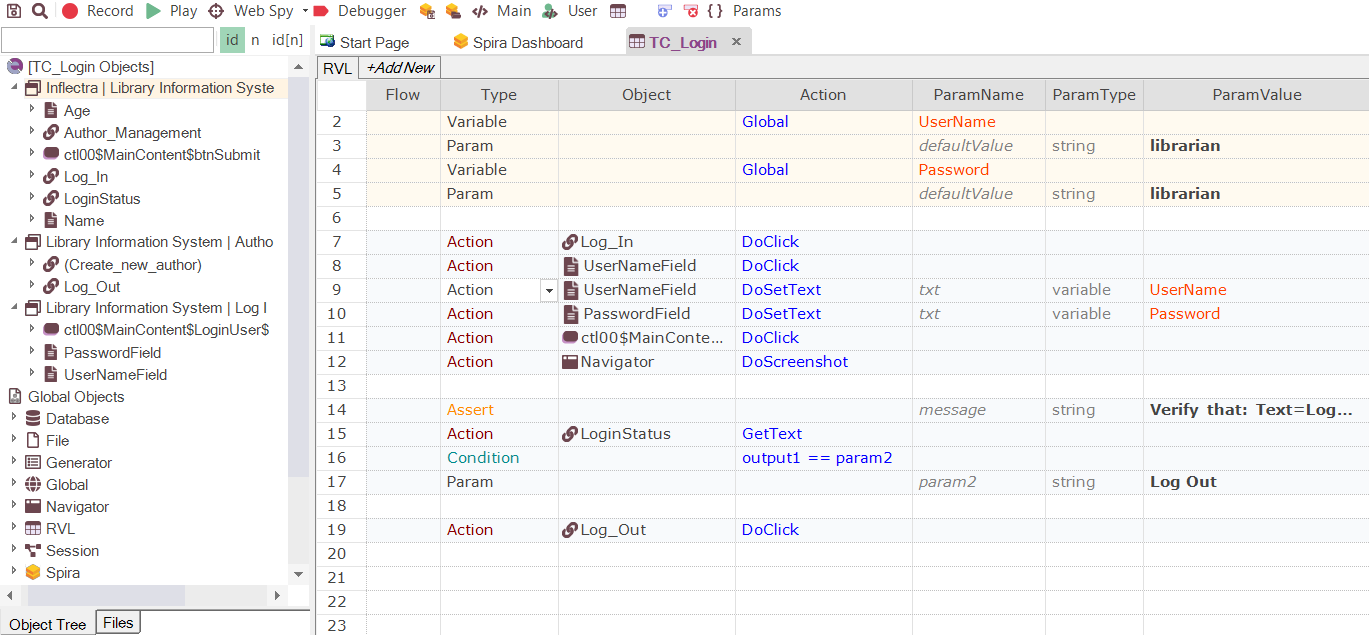
In addition, Spira is relatively inexpensive, and its concurrent user licensing means Rapise users only need a few licenses to handle reporting, analytics, and integrations. Rapise itself can easily integrate with other tools for:
- Inputs: All of the parts of Rapise tests are open, using well-known standard formats like text, XLSX, JSON, XML, and JS. Because of this, they can be edited separately or programmatically created using a script without binary/proprietary formats.
- Command line: Rapise tests can be executed via a command line from almost any external tool. Moreover, each test contains a ‘play.bat’ file to quickly launch this particular test case.
- Test results: Produced in several different standard formats. One of them is TAP (test anywhere protocol), which is a well-known text format and may be used to easily check test results and execute with other systems. Another option is to produce a report in HTML or XML.
- Pipelines: Integration with various DevOps tools is trivial if you use it with Spira. For example, there is an extension for Azure Pipelines that enables you to run a Rapise test set in a few clicks. If you proceed without Spira, then the integration is still possible, but you’ll need to put several actions into the pipeline definition.
- Testing targets: Another aspect of integration is handling the different testing targets. Rapise handles everything from the most common, modern protocols (UIAutomation, DevTools, WebDriver, REST, SOAP) to more complex and legacy technologies (IAccessibility, ActiveX, and more) that other tools like Katalon struggle with.
- Device farms: Rapise also supports all of the most common mobile and browser device farms (BrowserStack, Kobiton, SeeTest, SauceLabs), including extensible support for future platforms still being developed.
- CI/CD systems: As we mentioned previously, Rapise has open formats, so it can integrate with any environment that supports shell scripts and reads standard file formats. We have many Rapise customers who use it with:
- GitHub Actions
- Azure DevOps
- TeamCity
- Jenkins
- Custom CI/CD solutions
- Execute External Scripts: Rapise scripts may call other tools. For example, you can run an existing script to prepare a database or call a Postman command-line script to initialize an application via a web service. You can also do the same using Rapise’s built-in REST interface, but if there is an existing Postman script, then you can just call without needing to reinvent the wheel.
- Unit Testing: Rapise has integrations with many different unit testing tools. We provide examples of running Rapise tests using NUnit, MBUnit, and VSUnit. Other similar tools can be integrated in the same way (e.g. xUnit).
2. Version Control
Rapise supports multiple different types of version control systems for its scripts and other test assets. These include:
- Built in (using Spira Document repository)
- Git (external client)
- SVN, CSV (external clients)
3. Visual Testing, Self-Healing, AI
Rapise provides the following key artificial intelligence and machine learning capabilities:
- Self-healing tests where the system records multiple locators and looks for a change in the application to see if it is a probable match or not.
- Inflectra.ai to generate test cases and detailed steps, BDD scenarios, suggest risk mitigations, linked requirements, smart code snippets, unit tests, and more.
- Rapise can integrate with cloud-based AI and visual testing services such as Applitools as needed.
Learn more about Rapise’s AI capabilities here.
4. Open File Formats
Some tools use proprietary binary formats to store data and configuration — this helps vendors lock you into their solutions. In other words, even if all of the test data belongs to you, you still need their tool to open it. Everything in Rapise is open, and we use exclusively standard formats, preferably text-based, to make version control easier. So, if you need to generate or modify something, you may do it without even having Rapise installed.
5. Maintenance
Finally, the Achilles heel of test automation is test script maintenance. If you have to rewrite your tests every time the application or infrastructure changes, the ROI of automating tests becomes negative very quickly!
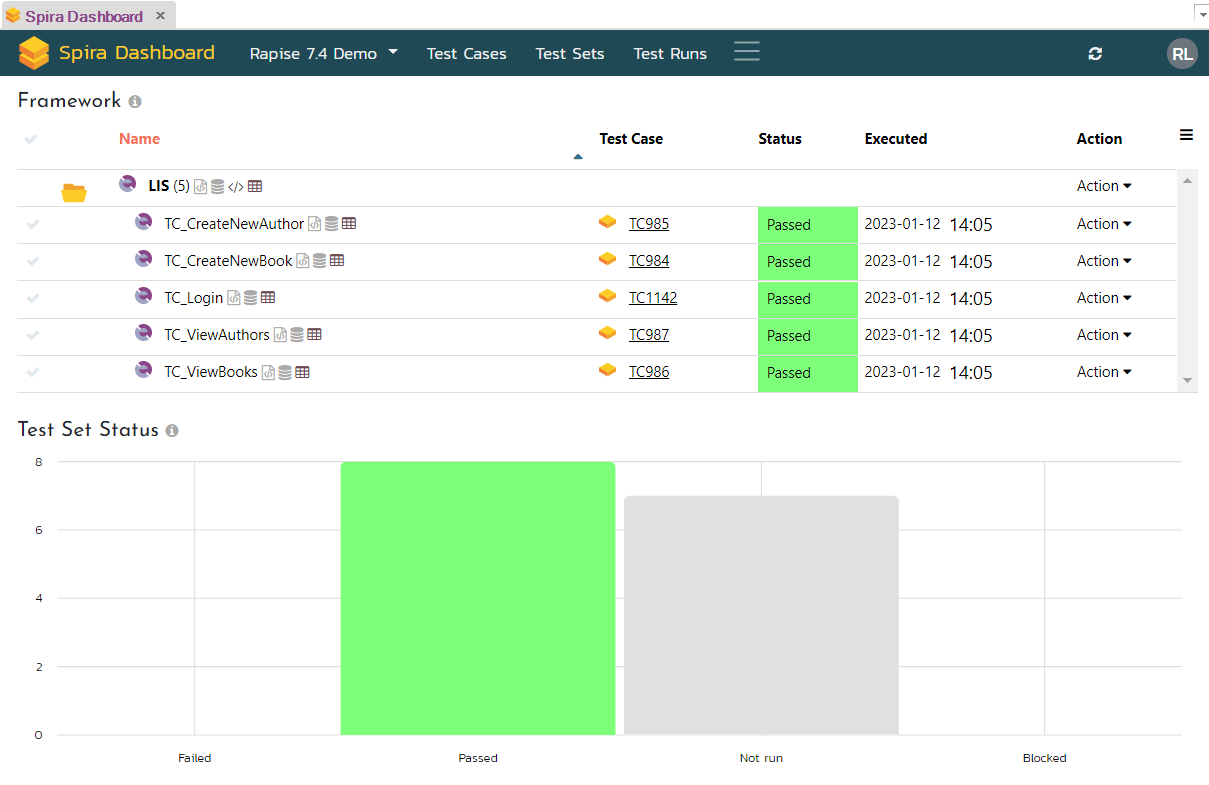
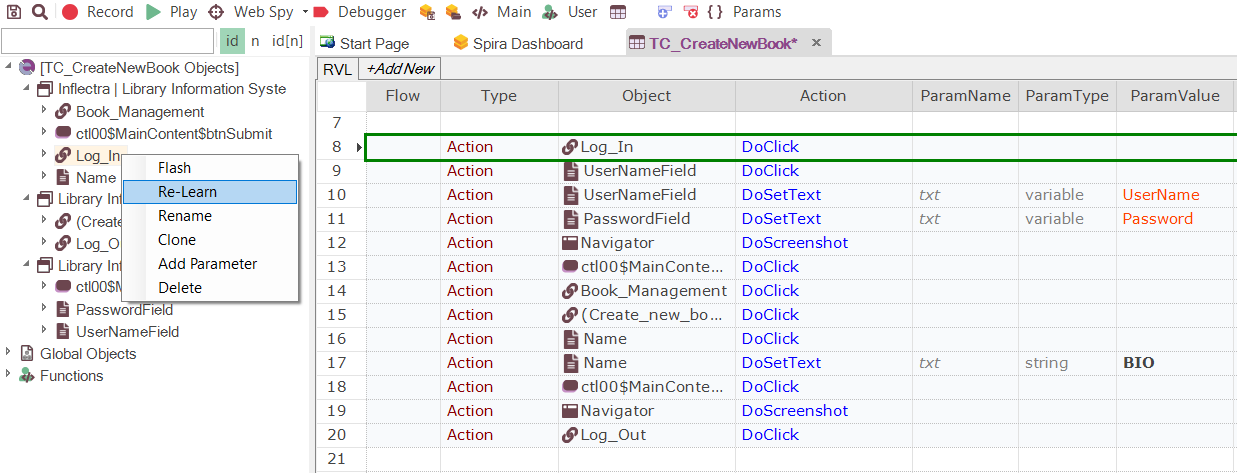
Rapise includes a key set of maintenance automation features intended to help you quickly fix, change, or upgrade your tests when your application changes.
Rapise vs. Katalon: Which is Right For Your Testing Pipeline?
Both Rapise and Katalon are strong automated testing tools, each with its own strengths and ideal use cases. Katalon is generally positioned as a “starter” or entry-level testing platform, being very easy to set up and get started. Rapise is better suited to teams with more complex projects, workflows, and governance, integrating more advanced features like AI-powered (but still SOC2 Type 2 compliant) test cases generation, risk predictions/mitigations, step-by-step QA guides, and smart code snippets that speak your devs’ language. For teams that don’t anticipate much change or expansion of requirements in the coming years, Katalon may suit your needs. For organizations that are looking to future-proof their automated testing and software QA, Rapise offers far more capabilities at a comparable or lower price tag.
Explore Rapise with the links below, or request a demo to see how it can upgrade your testing pipeline today:
DISCLAIMER: All information regarding the compared products has been made on the basis of information available on the product websites, from former customers, and analysis of trial installations of the product. The analysis and views expressed in this section and the information made available are purely those of Inflectra Corporation. It is possible that the compared products have additional features not mentioned in this whitepaper.
Try Rapise free for 30 days, no credit cards, no contracts
Start My Free TrialAnd if you have any questions, please email or call us at +1 (202) 558-6885